THE ZOOM PROBLEM
How to create intimacy and connectivity through Zoom?
My global Zoom class is so damn rewarding! Actors and directors all around the world are sending me self-tapes of their “Humans of New York” verbatim monologues and I am giving them feedback. Using the simple tools of Connection, Internal Landscape and Vista they are then re-taping and re-sending their performances. Oh my god! The difference is massive!
Ownership. Relaxation. Breath. Flow. Connectivity and responsiveness. Rich imagery. Unexpectedness... all these wonderful qualities are entering the work, based on these provocations.
Next they will be sending me their scenes. I can’t wait to watch.
THE TROUBLE WITH ZOOM
Of course all these actors are connecting with each other and taping via Zoom, Facetime or on Whatsapp — and you actors will know that many auditions are being conducted this way as well. Even your reader in a self-tape might be reading opposite you via Zoom, I certainly do that a lot with actors around the world.
So the question that my Zoom-class actors asked me in our last class was “How can you create a sense of intimacy, connection, confidence in conflict — through Zoom?”.
Over on the paid site I delve into detail on how I run my workshops in real life, using my simple exercises. I take you with me to Nepal where I encountered first hand some no-touch greetings of the Nepali and Tibetan people, which I now use as a precursor to my Connection-work.
And I take you to MOMA in New York and the incredible performance art piece by Marina Abramović who staged her famous show there, The Artist Is Present. In it, the artist Marina was indeed very present — for 8 hours every day she sat in the chair you see below in the video, and encountered thousands of people who queued for hours for the chance to see opposite her and be seen by her. In total, Abramović sat motionless for 736 hours and 30 minutes, engaging with over 1,500 strangers.
The curator told me “You have to be ready. In front of you will be an empty chair most of the time”… because nobody could imagine, in New York, the most busy place in the world, that anybody would take time to sit and just engage in mutual gaze with me”
— Marina Abramović
OK, SO HOW DOES THIS HELP ME WITH CREATING A CONNECTION OVER ZOOM?
This morning, before I wrote this article, I dialled up my husband Stuart and my daughter Davida in two separate Zoom-experiments. I wanted to see if we could do this Marina Abramović gaze-exercise on Zoom and get similar benefits to the way Marina and her gaze-partners did at MOMA, in 3-dimensions.
TIMING
In THE ARTIST IS PRESENT, there was no limit or guidance as to the time people would spend with Marina. Most visitors sat between 5 and 15 minutes. The longest individual sitting was a record-breaking 7 hours. (I can’t help thinking that would have been very annoying for all the other people in the queue that day!)
So for some guidance as to how long we should be gazing at each other, I went to another classic intimacy-experiment, The 36 Questions of Drs Arthur and Elaine Arun (1997). In a footnote to the OG experiment, the Aruns had added the idea of looking into each other’s eyes for 4 minutes.
And in her 2015 article about trying the 36 questions with a stranger (here’s the link) Mandy Len Catron says:
I know the eyes are the windows to the soul or whatever, but the real crux of the moment was not just that I was really seeing someone — but that I was seeing someone really seeing me.
(Reader — she married him. And that is why in 2015 the 36 Questions of Doctors Elaine and Arthur Aron went totally viral!)
THE TECH SPECS
Eye contact activates the brain’s social and emotional circuitry almost immediately
— Dr Susan J O’Grady, clinical psychologist and relationship therapist.
So, here I am below, trying out the four-minute exercise for you, with my daughter Davida. Here are some tips:
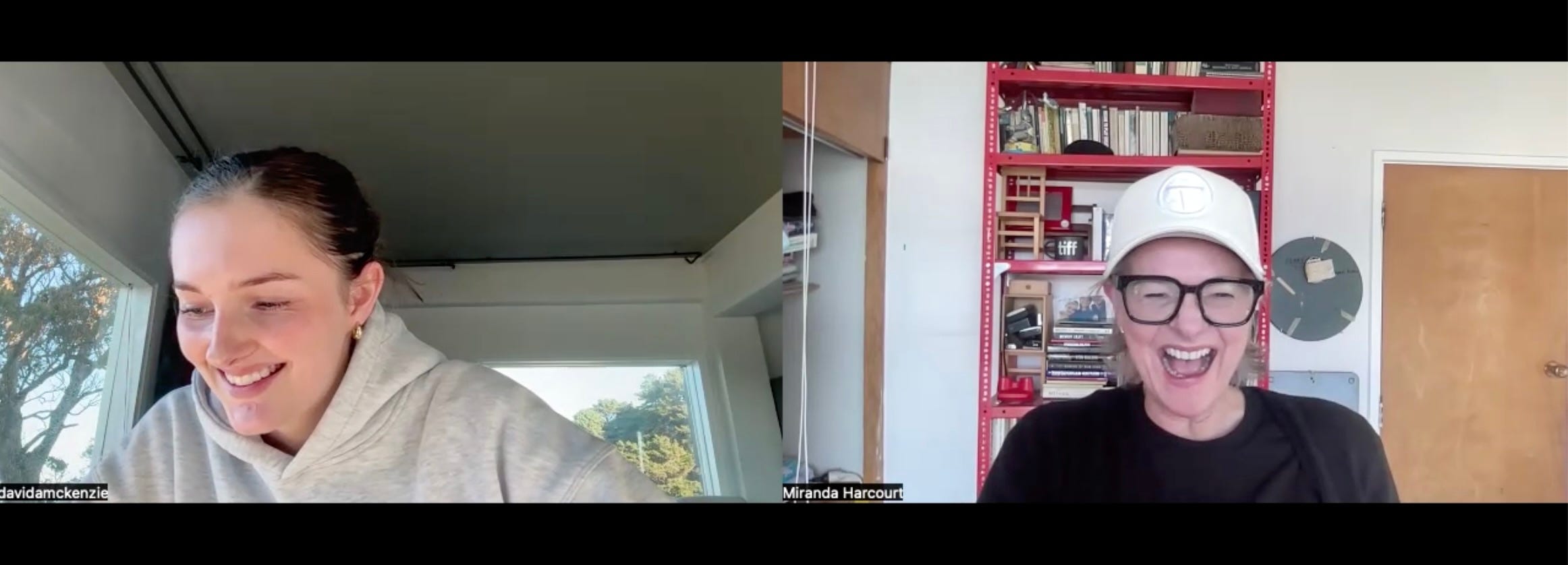
— In real life you can just look at the other person’s eyes. On Zoom though, as you will know, you have to look straight down the lens to be able to give the impression you are looking at your Zoom-partner’s face. So we decided to randomly flick our gaze between looking at the other person’s face to looking straight down the lens of the laptop, next to the green dot. This way we got the benefit of seeing the other’s face/eyes and also giving them a direct gaze. You can see the contrast in these two screenshots.


— Make sure you do a great job of setting your timer! In the final photo below, you can see Davida and me just after we realised that she had by mistake set the timer not for 2 minutes but for 14 hours!
ZOOM EYE CONTACT
And after 4 minutes, here are some of the words Stuart, me and Davida responded with:
Relaxed... intimate... charged... breath dropped-in... solar plexus softened... calming… peaceful… connecting.
So, dear reader — it seems that you do not need touch — to be able to connect across the space!